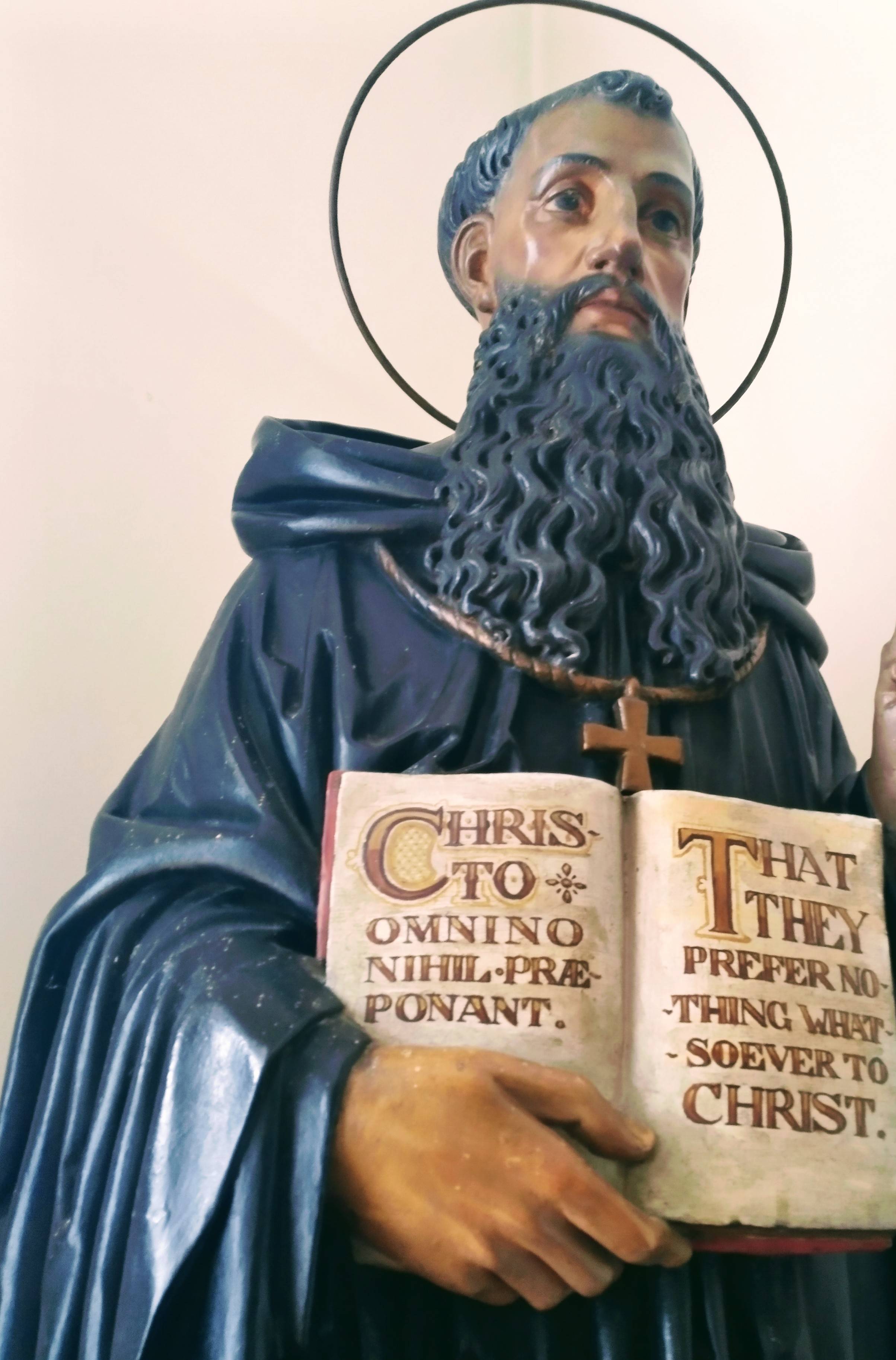
Cenobites (I)
CHAPTER I. Of the several kinds of Monks and their way of life
8 Jan. 9 May. 8 Sept.
It is well known that there are four kinds of monks. The first are the cenobites: that is those in monasteries, who live under a rule or an Abbot. The second are the Anchorites or Hermits: that is those who, not in the first fervour of religious life, but after long probation in the monastery, have learned by the help and experience of many to fight against the devil; and going forth well armed from the ranks of their brethren to the single-handed combat of the desert, are able, without the support of others, to fight by the strength of their own arm, God helping them, against the vices of the flesh and their evil thoughts. A third and most baneful kind of monks are the Sarabites, who have been tried by no rule nor by the experience of a master, as gold in the furnace; but being as soft as lead, and still serving the world in their works, are by their tonsure to lie to God. These in twos or threes, or even singly, without a shepherd, shut up, not in the Lord’s sheepfolds, but in their own, make a law to themselves in the pleasure of their own desires: whatever they think fit or choose to do, that they call holy; and what they like not, that they consider unlawful.
Chapter 1 of the Holy Rule, like much of the Prologue that precedes it, matches almost exactly the analogous chapter in the Rule of the Master. There is a notable difference, however, in the way the Chapter concludes. While the Master, like Saint Benedict, says that about the gyrovagues it is better to be silent than to speak, he in fact goes on to indulge for the next sixty verses in a satirical depiction of them. Saint Benedict, on the other hand, keeps his criticisms short and to the point. He then goes on to add some language of his own in describing his purpose to legislate for cenobites: while the Master refers to the genus of the cenobites as magnum, Saint Benedict uses the superlative, describing them as fortissimum genus, ‘the strongest kind’.
This superlative description of the cenobites is striking in view of the praise of the anchorites found earlier in the Chapter. An initial reading of the section on anchorites might lead to the conclusion that Saint Benedict considers the cenobitical life to be aimed at forming anchorites, as these are said to go out to the desert after long probation in the monastery. The implication would be that the solitary life is the real goal of monks, with the cloister simply being the school where they are prepared for it.
Yet such an understanding of the cenobitical life as merely a means to prepare for the solitary life hardly seems consonant with the remainder of the Holy Rule. We can perhaps detect here something of a creative tension between Saint Benedict and certain of his predecessors. Cassian and St Jerome, who each have their own discussion of the kinds of monks, do indeed seem to view the school of the cenobium as a training ground for future anchorites, who are viewed as clearly superior to cenobites, and perhaps this influences the Rule of the Master as well.
Saint Benedict, ever a man of tradition, does not wish to set aside this ideal of the solitary life. Indeed, the traditional teaching of the Church, as expressed even in the last century in Pius XI’s Apostolic Constitution Umbratilem, views the life of the solitary as being in itself the highest state of life that a Christian may aspire to, and for this reason canon law has always been favourable to religious passing from cenobitical to solitary life, as one is always free to aspire to a higher state.
Yet the entire tenor of the Holy Rule suggests that Saint Benedict, like Saint Basil before him, values the cenobitic life in itself to a degree that may not have been the case with some of his predecessors. Father Kardong notes that Saint Basil points out in his Rule various disadvantages of solitary life: ‘(a) We need material help. (b) Love turns toward others. (c) The criticism of others is invaluable. (d) The command to love others is best carried out in corporate works of mercy. (e) To be the body of Christ means common life. (f) All the gifts of the Spirit are not given to one person but to the community.’(Kardong, p. 37)
As we saw yesterday, the Prologue urges us to persevere in the monastery until death, and the Holy Rule concludes in Chapter 72 with a ringing exhortation to fraternal charity, and the prayer that Christ may lead us all together (pariter) to eternal life. The form of holiness that Saint Benedict’s Rule aims to teach, especially with its highly developed emphasis on the liturgical prayer of the Church, is a cenobitical holiness, in which the monastic family, as a microcosm of the Church, plays a fundamental role.
Thus, while Saint Benedict does honour the solitary vocation of the anchorite, it seems that the purpose of his description of it in Chapter 1 is intended not so much to present it as the normal goal of the monastic life, but rather to caution monks—perhaps based on his own experience—that if they aspire to this higher calling they must not think of attempting it without having first been trained in the cenobitical life. Otherwise, as Father Kardong’s commentary puts it, there is the danger of ‘avoidance of the painful task of conversion, which requires a supportive and confrontative community.’ (Kardong, p. 45)
Father Kardon goes on:
This could well be the meaning Benedict intends for his characterization of the cenobites as fortissimum: they are the ones who are willing to carry on the good fight with the ‘powerful and shining weapons of obedience’ (Prol 3). Unlike the other kinds of monks, they do not go it alone, but submit themselves to the searching but bolstering process of community life as a context for the search for truth and God. (Ibid.)
While most of us probably do not seriously desire to go off to be anchorites, all of us face the temptation to disengage from community life and think that we might be better off on our own. Chapter 1 is a challenging reminder that the communal character of our life is not simply a necessary evil, endured for the sake of convenience, but an indispensable means through which Our Lord wants to form our hearts on the model of His own divine charity.