
Homily for the Solemnity of Saint Patrick
The Week of the Patriarchs: Preparing for the Exodus
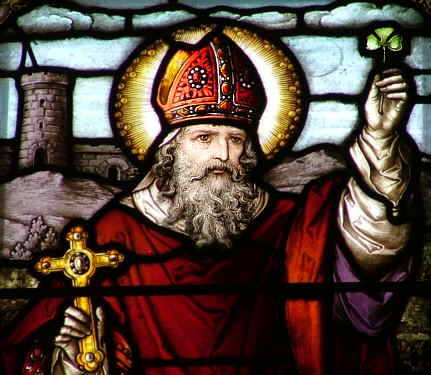
By God’s providence, as we approach Holy Week every year, we are given the “Week of the Patriarchs” to show us the way, this week in which we celebrate in succession three fathers within the Church: today, Saint Patrick,the father of the Church in Ireland; on Thursday, Saint Joseph, the father of the Church Universal; and on Saturday, the transitus, the passing to eternal life, of our holy father Benedict, the father of the Church in the monastic order.
Each of these men prepares us for the great event of our salvation that is coming. What is that event? It is the Pasch, the Passover from slavery to freedom through the new Exodus. Because of this, we fittingly contemplated on Sunday the prophet Moses, the liberator, the lawgiver of God’s people. In Sunday’s Gospel, we were presented with our Lord as the fulfilment of the type, as the new Moses, the perfect Prophet and Liberator and Lawgiver. And each of the men, each of the father figures, whom we honour this week fulfils in his own way the pattern of the life and mission of Moses.
Moses, a fugitive in a foreign land, encountered at Mount Horeb, in the burning bush, the living God Who changed his life and sent him to deliver His people from their bondage. Despite his slowness of speech, despite what he knew was his great inadequacy, Moses carried out his mission. He confronted Pharaoh, the most powerful ruler of the ancient world, and all of his magicians. He delivered Israel from slavery. He gave them a law. He set rulers over them. Above all, he interceded for them in the presence of God–God who spoke to him intimately as a man speaks to his friend. And so through him, Israel became a royal priesthood, a holy nation. (Cf. Ex 19:6; 1 Pet 2:9)
Saint Patrick, A New Moses
Saint Patrick, as he emerges for us in his own words in his Confession written towards the end of his life, shows a vocation and a mission not unlike that of the great lawgiver of Israel. Patrick too found himself not just a fugitive but a slave in a foreign land. But it was there in that foreign land that he encountered the God Whom he had not served well in his youth. There, in the land of his exile, he came to know God. There he learned how to pray:
…after I came to Ireland–every day I had to tend sheep [as Moses was tending the sheep of his father-in-law Jethro], and many times a day I prayed–the love of God and His fear came to me more and more, and my faith was strengthened. And my spirit was moved so that in a single day I would say as many as a hundred prayers, and almost as many in the night, and this even when I was staying in the woods and on the mountain; and I used to get up for prayer before daylight, through snow, through frost, through rain, and I felt no harm, and there was no sloth in me–as I now see, because the spirit within me was then fervent. (Saint Patrick, Confession 16, in The Works of St. Patrick, translated by Ludwig Bieler, Ancient Christian Writers, vol. 17)
Having encountered the living God, Patrick received the divine call, the call to deliver God’s people from bondage, as he read in a dream a letter entitled “The voice of the Irish”, the Irish calling to him to walk among them again. “Thanks be to God,” he writes, “after many years, the Lord gave to them according to their cry.” (Conf. 23) As He heard the cry of His people Israel in their bondage, so He heard the cry of the Irish. He sent Patrick to deliver them.
Like Moses, Patrick was deeply aware of his unworthiness by any human standard:
Whence I, once rustic, exiled, unlearned…this at least I know most certainly that before I was humiliated I was like a stone lying in the deep mire; and He that is mighty came and in His mercy lifted me up, and raised me aloft, and placed me on the top of the wall….Wherefore, then, be astonished, ye great and little that fear God [Apoc 19:5], and you men of letters on your estates, listen and pore over this. Who was it that roused up me, the fool that I am, from the midst of those who in the eyes of men are wise and expert in law?…He inspired me–me, the outcast of the world–before others, to be the man (if only I could!) who…should faithfully serve the people to whom the love of Christ conveyed and gave me for the duration of my life. (Conf. 12-13)
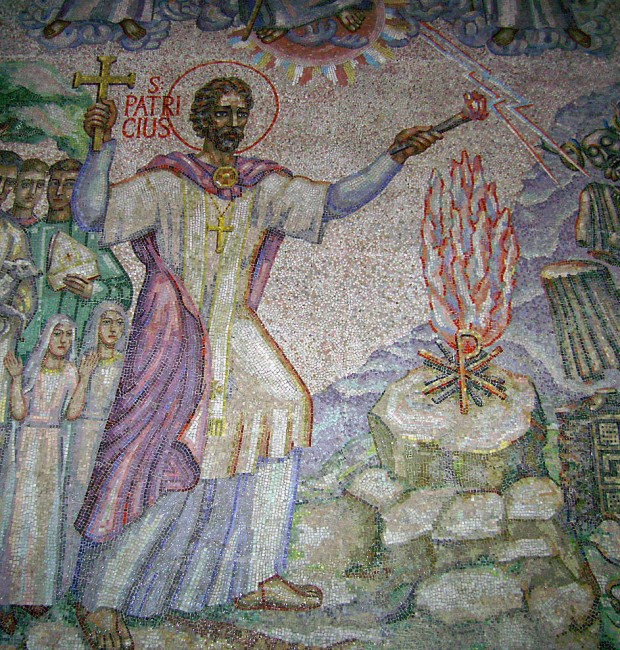
 Despite his inadequacy, Patrick went to Ireland, relying on the spirit of God. He confronted kings, he confronted their magicians, and he delivered Ireland from its spiritual slavery, not by force of arms but by the power of God. Like Moses, he gave to this new people of God the Law, the Scriptures. He set priests over them throughout the island. Above all, he interceded for them. Legend has it that he obtained from God the privilege to judge the Irish on the last day. What is certain is that he, like Moses, was ready to lay down his life for the people entrusted to him. And so he writes towards the end of his confession:
…may God never permit it to happen to me that I should lose His people which He purchased in the utmost parts of the world….And if ever I have done any good for my God whom I love, I beg Him to grant me that I may shed my blood with those exiles and captives for His name, even though I should be denied a grave, or my body be woefully torn to pieces, limb by limb by hounds or wild beasts, or the fowls of the air devour it. (Conf. 58-59)
Patrick, like Moses, longed to lay down his life, to put himself on the line, for the people entrusted to him. And so, through his prayers and through his labours, Ireland became a royal priesthood, a holy nation.
All Is Grace
What does Patrick teach each of us? He teaches us that God does not choose the perfect. He does not choose those whom the world would consider qualified. Throughout his Confession, Patrick returns over and over again to the theme of his rusticitas, his “rusticity”, his lack of human culture and education. And he returns even to the memory of his sins, his sins as a youth which had been brought up to shame him as he was about to take on his mission as a bishop. He doesn’t deny any of this. He knows that all is grace.
He writes,
I pray those who believe and fear God, whosoever deigns to look at or receive this writing which Patrick, a sinner, unlearned, has composed in Ireland, that no one should ever say that it was my ignorance if I did or showed forth anything according to God’s good pleasure; but let this be your conclusion and let it so be thought, that–as is the perfect truth–it was the gift of God. (Conf. 62)
Friends of God
Patrick knew that everything that was in him was the grace of God–the grace of God given through prayer. For that is how Patrick emerges for us from his writing: as a man of deep prayer, intense prayer, a man like Moses who conversed intimately with God.
We cannot, most of us, imitate literally everything that we heard about Patrick in the Second Nocturn of Matins this morning, how he would divide the night into three portions:
…during the first, he repeated the first hundred Psalms, and bent his knees two-hundred times; during the second he remained plunged in cold water, with heart, eyes, and hands lifted up to heaven, and in that state repeated the remaining fifty Psalms; during the third, he took his short rest lying upon a bare stone.
Not something that we should try to imitate the letter–but all of us can and must imitate Saint Patrick in being men of ceaseless prayer, friends of God who converse with Him intimately. And if we are the friends of God, then, like all friends, we will love what God loves, which is the salvation of our neighbour. And in the place where God’s providence has called and placed each of us, we will, with Patrick, be willing to give our lives in charity, in word and example, in prayer and sacrifice, for the salvation of those who are in bondage to sin. And so may all of us be imitators of our father Saint Patrick–imitators of the great liberator, Moses–above all, imitators of our only true Father and Lawgiver and Redeemer, our Lord Jesus Christ, Who has made us a royal priesthood, a holy nation.