
The Story of Mother Mectilde and the Vocation of Perpetual Adoration

The Monastery of Our Lady of the Cenacle (Silverstream Priory) traces its spiritual origin to the Benedictines of Perpetual Adoration established by Mother Mectilde de Bar.
Here follows the account of how Mother Mectilde was led to establish the Benedictines of Perpetual Adoration. The story begins in Paris, where Mother Mectilde was already a Benedictine and the superioress of a monastery in the Rue du Bac.
Civil Unrest and Poverty
In March 1651, Mother Mectilde, together with four companions, arrived in Paris, fleeing from the war that was ravaging their native Lorraine. They found the capital in turmoil, as the rebellion known as the Fronde was raging against King Louis XIV. The city gates were blocked, and the populace was threatened with starvation. The nuns from Lorraine found refuge in a “hospice” called Le Bon Ami (a former house of prostitution) in the Faubourg Saint-Germain. They had not so much as a bale of hay on which to sleep, and practically nothing to eat. The future was very dim indeed.
Temptation to Flee
All of this took its toll on the thirty-six year old Mother Mectilde, who at this time thought of withdrawing completely from what seemed to her an impossible situation. She seriously considered exiling herself in the south of France to live as a hermit in the mountainous wilds of Sainte-Baume, the region that, according to tradition, was the place of Saint Mary Magdalene’s long solitary penitence.
A Word in the Night
But on Easter night 1651, an interior voice spoke to Mother Mectilde, saying, “Renounce, adore, and submit to My designs”. In the grace of this word, she gave up her project of living as a hermit and, in pure faith, embraced the mysterious plan of God.
Mother Mectilde and Abba Arsenius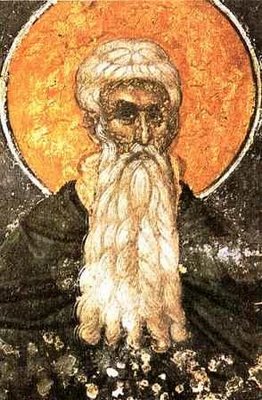
One cannot help but compare this word spoken to Mother Mectilde with a similar word given to Abba Arsenius: Fuge, tace, quiesce, “Flee, be silent, be at rest.” Mectilde is told to flee from her own projects, desires, and fears. She is told to be silent and adore God, perfect and loving in all His designs. Finally, she is told to submit, that is, to bow low beneath the Hand of God, to be at rest in cleaving to His Will with an unconditional and irrevocable “Yes”.
The three words that Mother Mectilde heard spoken in her soul contain all that is necessary for one to be happy in this life and in the next. Would that we had the wisdom to repeat them to ourselves every time we experience temptation, fear, disappointment, or darkness: “Renounce, adore, and submit.” These three words, in effect, go to the heart of what has been called the Mectildian-Benedictine charism.
Give Us This Day Our Daily Bread
Mother Mectilde’s surrender to God’s designs did not go unrewarded. The day came when there was no bread in the house. With her community around her, Mother Mectilde knelt down to say the Our Father. An instant later, who should arrive at the house but Monsieur de Margeuil, physician to Mother Mectilde’s compatriot, the Duchess of Orléans, Marguerite de Lorraine. De Margueil, appalled by the destitute conditions he discovered, appealed to the Duchess of Lorraine for help. Without delay, a group of charitable noble ladies arrived in a flurry, bringing relief: the Marquise de Boves, the Marquise de Cessac, Madame Mangot, Charlotte de Ligny, and Marie de la Guesle, the Countess of Châteauvieux, who would become Mother Mectilde’s closest spiritual friend.
 A Friendship

The indefectible friendship that grew up between the enclosed Benedictine and the grand lady of the world bore fruit in a remarkable correspondence. The Countess treasured Mectilde’s letters to her, and gathered them into a volume that she called her “breviary”. Happily, the so-called “breviary” of letters was copied, and has survived to the present. A few years ago, an oblate of our monastery translated these letters, which have been published as The Breviary of Fire. This correspondence represents, on the part of Mother Mectilde, a remarkably astute and demanding ministry of spiritual direction. The relationship between Mother Mectilde and Marie de la Guesle resembles, in many ways, that between Saint Teresa of Avila and her friend, the Duchess of Alba. The Countess would go on to play a providential role in the work to which God was about to call Mother Mectilde.
On the Move Again
It became evident that Mother Mectilde’s little community would have to find a house better adapted to monastic observance than their somewhat makeshift lodgings in the hospice of Le Bon Ami in the rue du Bac. Several offers came her way: among them were a priory at Vire in Normandy; a convent in Paris that would amalgamate all the homeless and wandering religious of the capital; a proposed foundation in the suburb of Saint-Marcel that would be connected with the Jansenist community of Port-Royal. Mother Mectilde refused all these, in particular the connection with Port-Royal. She would have nothing to do with the Jansenists. The gentlemen of Port-Royal, miffed by her refusal, cut off all donations to Mother Mectilde’s community.
The Idea of Perpetual Adoration
While all of this was going on, one Abbé Gontier, treasurer of the Sainte-Chapelle of Dijon and vicar general of Langres, proposed to Mother Mectilde that she should establish perpetual adoration of the Most Holy Sacrament in her monastery. This worthy priest had, of his own initiative, established in all the parishes of his diocese the recitation of an amende honorable — we would say an act of reparation — every Thursday. This amende honorable was read by a priest, kneeling before the monstrance, and holding a lighted taper in his hand. Mother Mectilde found the idea attractive. Elements of the practice were later incorporated into the ritual of the Benedictines of the Most Holy Sacrament. Mother Mectilde proposed the practice to a group of noble ladies, all friends of hers who, influenced by Monsieur de Bernières, saw in the project a means of keeping Mother Mectilde in Paris.
A Strange Painting and Its Effect
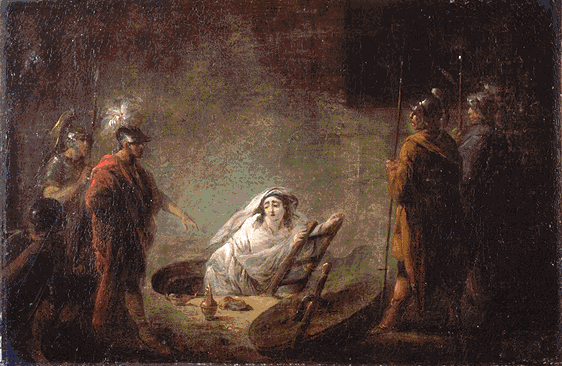 Then something very curious happened. One day when Mectilde was visiting her friend, Madame de Boves, she noticed a painting that depicted ancient pagans rendering homage to an idol set upon an altar. A pagan priest surrounded by priestesses knelt in adoration, holding lighted candles in their hands. A sacred fire was burning in the background, tended by vestal virgins, while in the distance torturers were punishing negligent virgins. (The vestal virgins were a group of priestesses in ancient Rome dedicated to the service of Vesta, goddess of the hearth. Vestal virgins who neglected the sacred fire or violated their vow of chastity were severely punished.)
However bizarre one may find all this, the Spirit of God used it to touch Mother Mectilde’s heart. A short while before this incident, a priest had said to her, “Rejoice, because God intends to use you to accomplish something very great for the honour of the Most Holy Sacrament. Prepare yourself. God revealed this to me during Holy Mass.”
Idolators Will Rise Up to Judge Us
As Mectilde contemplated the strange painting, the prophetic words of the priest came back to her. She began to think, “By means of this idolatrous work of art, God is inciting me to an assiduous presence before the tabernacle, that he might be adored at all hours of the day and night.” Turning to the Marquise de Boves, she said, “Madame, the idolators will one day rise up to condemn us, for we Christians show such little respect for the Blessed Sacrament in our churches. Alas! Shall we not do for our God what the pagans did for their false gods? Why, in the house where God continually dwells, is He not continually adored? Why do not virgins here on earth sing unceasingly the canticle of the Angels before His altars? Why do the sentinels of Israel not keep watch, by day and by night, before the throne of the New Solomon of the New Law?”
Prophecies and Visions

Mother Mectilde, in pronouncing these words, was not unaware of the predictions made by a number of mystics known to her. Barbe, a poor maidservant of Compiègne, directed by none other than the great Father Charles de Condren, successor to Cardinal Bérulle as Superior General of the French Oratory, had prophesied: “There will come a time in which there will be religious totally dedicated to the adoration of the Most Holy Sacrament.” Monsieur Gaston de Renty, one of the outstanding spiritual figures of Normandy, had said, “Very soon there will be an institute of religious wholly dedicated to the worship of the Most Holy Sacrament. They will be chosen souls.” And, in Paris itself, Marie de Gournay, a wine merchant’s wife, had a vision in which she saw the future monastery, and heard the words, “Behold the work of my servant Catherine.”
God Provides Funding
Mother Mectilde’s reflection on the painting so struck Madame de Boves, a woman already animated by a fervent Eucharistic piety, that she resolved to do all in her power to promote the foundation of a monastery of perpetual adoration. Together with the Countess of Châteauvieux, and Madames Cessac and Mangot, she raised a total of 31,000 pounds for the establishment of a monastery of reformed Benedictines in which, “ceaselessly, by day and by night, the Most Holy Sacrament of the Altar would be adored to make reparation, insofar as possible, for the lack of respect, indifference, profanations, sacrileges, and offenses committed against this most adorable Sacrament.”
A Charism, A Mission
These Benedictine adorers would, further, beg God to take pity on France, to grant peace in its borders, and to protect the King. Their mission would be to make up for the failure of so many souls to show reverence for the Most Holy Sacrament, either by ignorance or malice. They would adore Jesus Christ truly present in the Sacrament of His Love for the sake of those who do not adore, or refuse to adore, or never thinking of pausing in adoration before Him.
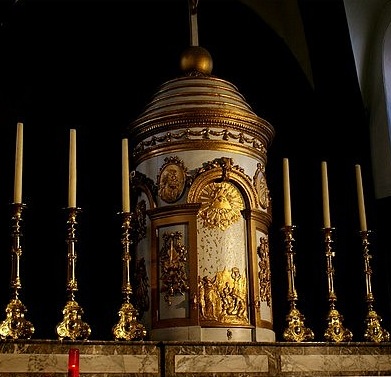
It is significant that for Mother Mectilde and indeed for the Church of her time, Eucharistic adoration was not synonymous with exposition of the Most Blessed Sacrament in the monstrance. Exposition was reserved for special occasions, marked by a festive solemnity and by a loving display of artistry and beauty in homage to the Eucharistic King. The practice of exposition on Thursdays transformed every Thursday into a weekly feast of Corpus Christi. On ordinary days, the perpetual adoration was carried out before the closed tabernacle, mindful of the words of the prophet Isaias, Vere tu es Deus absconditus, Deus Israel Salvator; “Truly Thou art a hidden God, O God of Israel, the Saviour.” (Isaias 45:15)
The new monastery would bind itself to the celebration of the Mass and Office of the Most Blessed Sacrament (that of the feast of Corpus Christi) every Thursday, and to exposition of the Blessed Sacrament in the monstrance until the end of Vespers on Thursday as well. A touching detail: in addition to the oil lamp burning before the Most Holy Sacrament, they promised to keep a lamp burning before the image of the Blessed Virgin Mary every Saturday.
Thus did the form and spirit of the new monastery begin to emerge from the hearts of Mother Mectilde and her friends: to adore and make reparation for the indifference of so many Christians to the Sacrament of Our Lord’s Love. Mother Mectilde promised to execute the project within two years’ time.
Navigating the Avenues of Ecclesiastical Jurisdiction
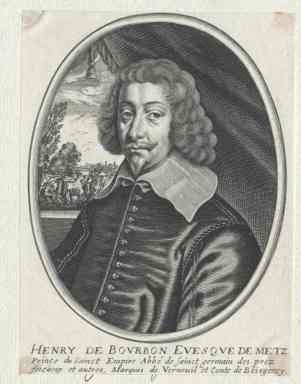
One does not found a monastery without obtaining ecclesiastical authorization. Monasteries come to birth, and develop, and thrive within the Body of Christ, that is the Catholic Church. At the time of Mother Mectilde de Bar, the avenues of ecclesiastical jurisdiction were exceedingly complex. Given that Mother Mectilde and her little community were living in the territory of the Abbey of Saint-Germain-des-Prés in Paris, she needed, first of all, to secure the permission of the abbot of Saint-Germain-des-Prés, the natural son of Henri IV, who was the Duke of Verneuil, the bishop of Metz.
The Request Refused
The Abbot-Duke was utterly opposed to the foundation of new monasteries. Paris, he argued, was already cluttered with too many cloisters vying for economic support. He had promised the Queen Regent, Anne of Austria, that he would forbid the foundation of new monasteries in his territory. Already, for lack of resources, six ancient communities under his authority had ceased to exist. In vain did the Countess of Châteauvieux beg the Queen to make an exception; the Queen remained inflexible.
A Vow in Time of Crisis
Divine Providence was at work, all the same. “We know that to them that love God, all things work together unto good, to such as, according to His purpose, are called to be saints.” (Romans 8:28) France was in complete turmoil. Forces in rebellion against the crown were gaining ground. The court was obliged to flee to Compiègne. The Queen Regent learned, to her dismay, that the rebellion had spread from Paris and Bordeaux to Orléans and Angers. In desperation she turned to the Abbé Picoté, a priest of Saint-Sulpice, and beseeched him to make whatever vow he thought necessary to obtain from God the return of peace, order, and stability to France.
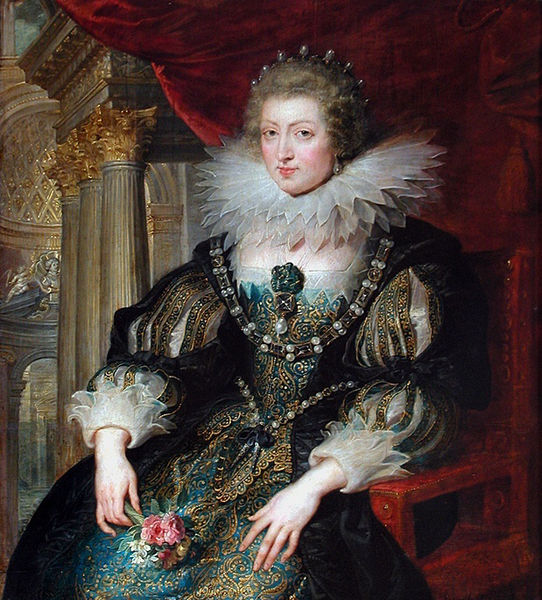
Anne of Austria
The Queen’s Vow: Adoration and Reparation
The good priest, knowing absolutely nothing of Mother Mectilde’s proposed foundation, vowed that if tranquillity were restored to France, the Queen would found a house of religious vowed to adoration of the Most Blessed Sacrament in reparation for the outrages committed against the Sacred Body of Christ. The Abbé Picoté, in all likelihood, had heard that the consecrated Host was, more than once, trampled under foot by soldiers, and even fed to their horses. Miraculously, no sooner was the vow made in the name of the Queen than the whole situation changed. On 21 October 1652, Louis XIV entered Paris in triumph. The revolt was over; peace returned.
The Royal Yes
In the meantime, the Abbé Picoté learned of Mother Mectilde’s project. Struck by the affinity between the vow he had made in the name of the Queen and the foundation that Mother Mectilde desired to undertake, he spoke of it to the Queen on 8 December 1652 while the latter was in retreat at the Benedictine abbey of Val-de-Grâce. The graces of the retreat must have been in operation because he found the Queen well disposed. In execution of her vow, the Queen ordered the Duke of Verneuil to authorize the foundation in his territory of Saint-Germain-des-Prés. The Duke-Abbot immediately entrusted the whole affair to his Vicar General, Dom Roussel, a Benedictine of the Congregation of Saint-Maur, and the prior of Saint Germain-des-Prés.

Difficulties
After the Queen’s authorisation for Mother Mectilde to found a community of Benedictine nuns of Perpetual Adoration, Mother Mectilde and her community now found themselves under the authority of Dom Placide Roussel, the prior of Saint-Germain-des-Prés. From all accounts, Dom Roussel was anything but placid, in spite of his name. A Benedictine of the Congregation of Saint-Maur, Dom Roussel was a difficult man: legalistic, pessimistic, stubborn, and authoritarian. He had the talent of seeing difficulties where no one else could see them. More than once, Mother Mectilde and the Countess de Châteauvieux returned completely discouraged from a meeting with Dom Roussel. To a friend, Mother Mectilde wrote, “We were to see the Reverend Father Prior who, as much as possible, turns everything upside down.”
Dom Roussel required that Mother Mectilde puchase land to build a future monastery and that she collect a large sum of money to assure the upkeep of a community of five. His demands blocked the establishment of the monastery at every turn.
Dom Roussel Relents
Mother Mectilde held her peace; she prayed, did penance, and waited. On 24 March, 1653, in response to an intervention by Madame de Châteauvieux, the dreaded Dom Roussel surprised Mother Mectilde by sending her a message authorizing exposition of the Most Blessed Sacrament for the following day, the feast of the Annunciation. Benefactors of the monastery had previously provided a chalice, patien, monstrance, and thurible, so that all would be in readiness once the long-awaited permission came.
The First Solemn Exposition
On the feast of the Annunciation, then, 25 March 1653, Holy Mass was sung in the Oratory of the house, and the Most Blessed Sacrament was exposed in the monstrance. Alerted at the last minute, a considerable number of the faithful attended the celebration. During Holy Mass, Mother Mectilde saw the Most Holy Virgin Mary, clothed in the raiment of an abbess, and holding the crosier in her hand. Our Lady presented the nascent community to Jesus the Host, as victims offered to His Eucharistic love. Even today, the Benedictines of the Most Holy Sacrament consider this feast of the Annunciation 1653 as the first solemnity of perpetual adoration of the Institute.
Mother Mectilde wrote to Madame de Châteauvieux, “All that paradise loves and adores, I now possess, thanks to you.”
Stability Amidst Life’s Chances and Changes
One of the most encouraging things about the lifelong journey of Mectilde de Bar is that she was often obliged to leave one place for another, to begin afresh, and to adapt to new circumstances. Again and again she experienced change, keeping always her heart fixed where true joys are found: in the adorable Sacrament of the Altar, as in the heavenly sanctuary not made by hands.
Trust and Perseverance
In times of social upheaval and unrest, as in times of upheaval and unrest in the Church, the ideal of monastic stability is often shattered against the jagged rocks of reality. Happily, God calls us, not to an ideal, but to utter trust in Him and to humble perseverance in the face of things as they are — imperfect, gritty, and disappointing — even if this means beginning afresh over and over again. Catherine Mectilde de Bar is a model of just this. God can and does, in fact, use such paradoxical and disconcerting circumstances as a crucible in which he hammers out something something new, something purified, something conceived in the infinite love and wisdom of His Heart.
By God’s providence, Mother Mectilde was surrounded by supportive and faithful friends who believed in her vocation and made sacrifices in order for her work, Our Lord’s work, to prosper. Thus, when it became clear that, because of the lack of space at the house in the rue du Bac, the little community had to relocate once again, they were able to move to a rented house belonging to Madame de Rochefort in the rue Férou, close to the church of Saint-Sulpice. There, on 12 March 1654, the Father Prior of Saint-Germain-des-Prés, Dom Roussel, who by this time had nuanced his opinion of Mother Mectilde’s community, established the monastic enclosure.
Memorable Day
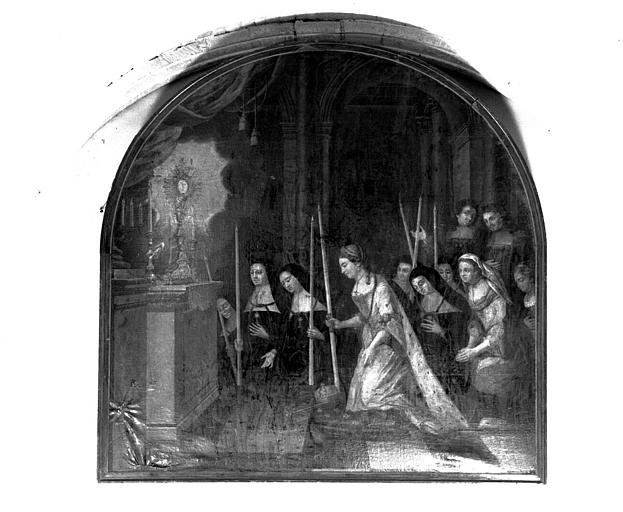
On the same day, the mother of Louis XIV, Anne of Austria herself, arrived at the new monastery with an imposing retinue of courtiers. She directed Dom Roussel to afix the cross to the wall above the door of the house, and established it officially as a royal foundation. Dom Roussel blessed the bell, the oratory, and the regular places. During a Solemn Mass, a Carmelite of Les Billettes, one Père Léon, preacher to the Queen, delivered the sermon. At the end of Holy Mass, the Blessed Sacrament was exposed in the monstrance.
The Amende Honorable
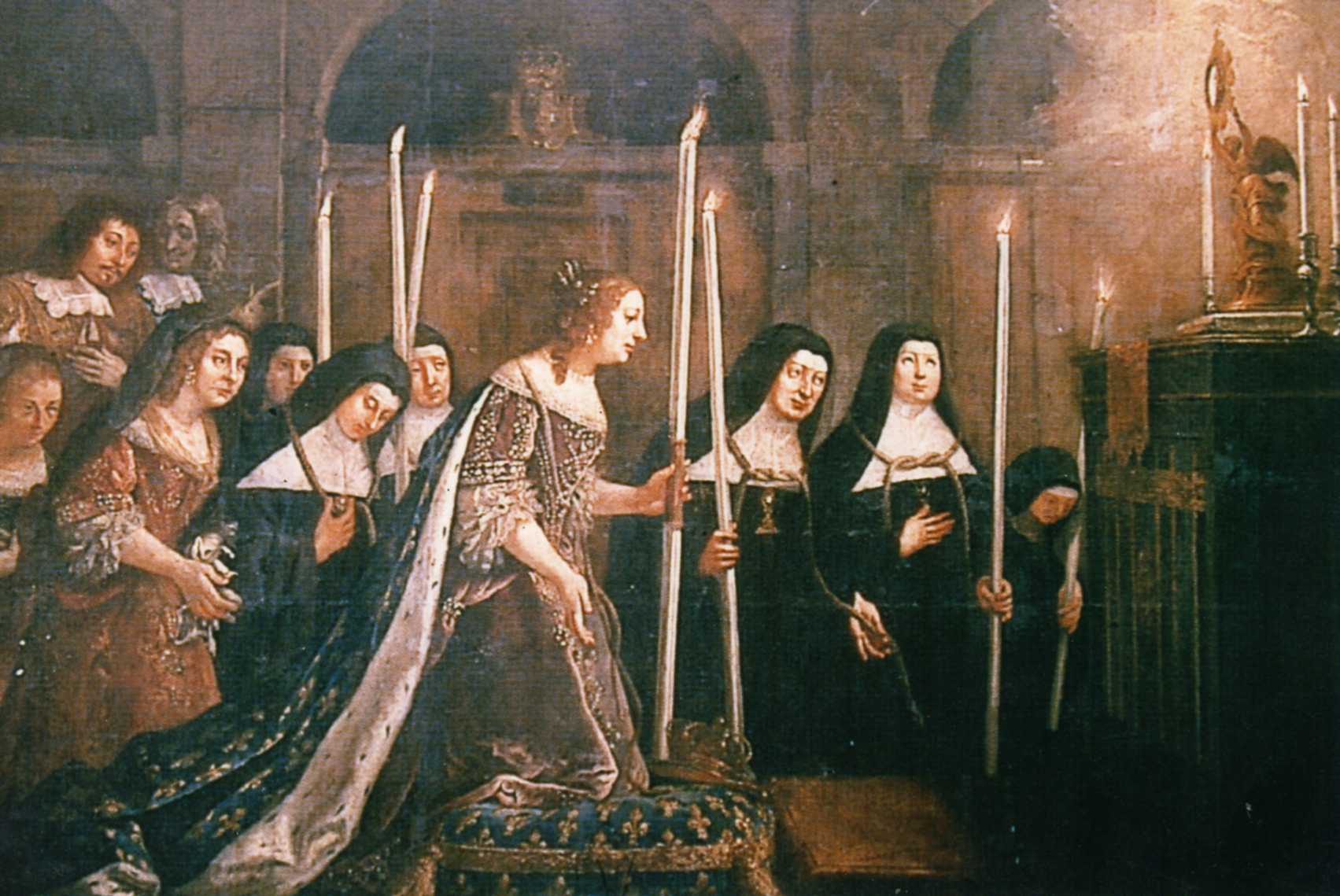
That afternoon, la musique du Roi, Louis XIV’s own musicians, presented their homage to Jesus Christ, the Eucharistic King enthroned upon the altar. Then, before Benediction of the Most Blessed Sacrament, Anne of Austria advanced to the middle of the choir, knelt in adoration, and with a cord about her neck and a burning taper in her hand, read the Amende Honorable, or act of reparation, composed by Mother Mectilde. As the Queen gave utterance to Mother Mectilde’s prayer, it was the voice of France that reached the ears of God, making reparation for the countless offenses, sacrileges, and outrages perpetrated against the Sacred Host.
The Painting
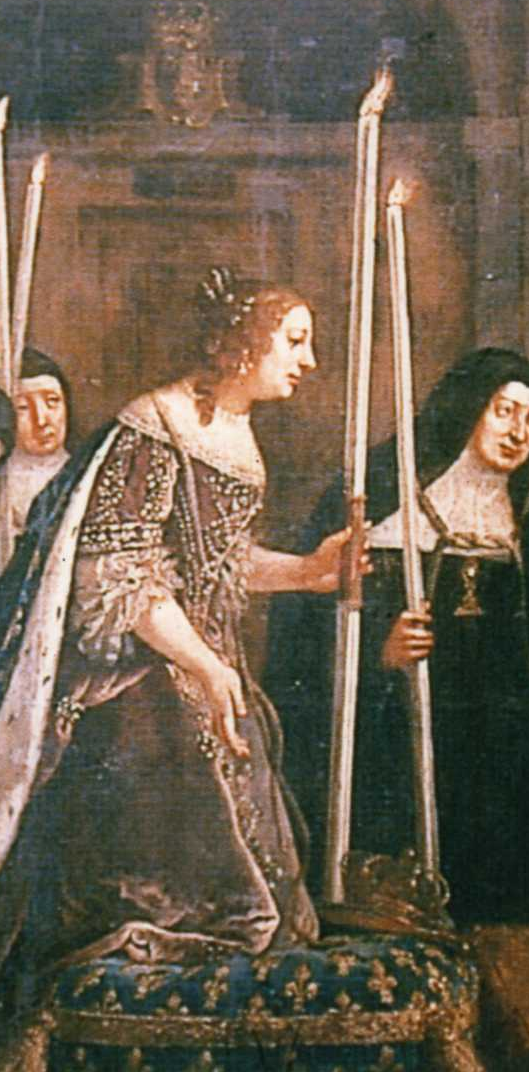
Philippe de Champaigne (1602-1674) immortalized the solemn scene in the painting reproduced above. Looking at it from left to right, we see two gentleman courtiers, finely dressed. The one whose face is in shadow is whispering a comment to the other, while he points to the altar. His companion is listening to him, but appears more recollected and moved. His head is bowed; his face bears an expression of sweetness and compunction. Kneeling in front of the gentlemen are two ladies in waiting; they too appear awed by what is taking place. They have to take their cue from the Queen. There are six Benedictines, each one with the cord that symbolizes identification with the Suffering Servant about her neck, and a burning candle, the symbol of readiness and love, in her hand.

Anne of Austria
Anne of Austria has removed her crown and placed it on the cushion at her feet, leaving her bareheaded. She too wears the cord about her neck, and carries the burning candle, a sign of her self-offering in adoration and in reparation. For all her royal finery, her face reveals an inward simplicity of soul. One senses that she is a good woman.
Face to Face
Mother Mectilde is the figure next to the Queen. In Mother Mectilde’s features, there is gentle majesty. Her whole being appears drawn to the altar, to the monstrance, to the Eucharistic Face of the Son of God. Of all the faces depicted in the painting, that of Mother Mectilde is, I think, the most expressive. The little nun crouching next to the altar represents l’anéantissement, en-nothingment, profound humility in the presence of the Divine Majesty.
Our principal application in prayer must be to hold ourselves before the greatness and supreme majesty of God in the Most Holy Sacrament, with the most profound respect, with total confidence and abandonment, with submission, accepting simply all the dispositions of Divine Providence, each one according to her degree of grace, either by making acts [of prayer] or in some other way. (M. Mectilde du Saint-Sacrement)
12 March, 1654
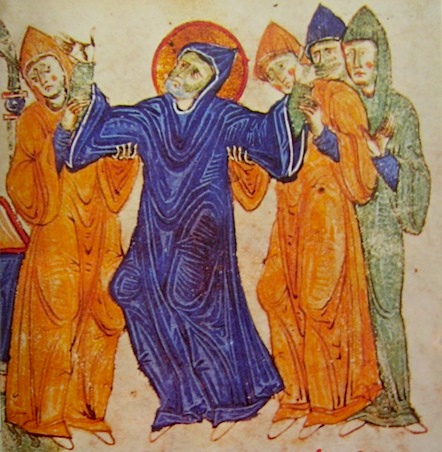
Peace had returned to the kingdom of France after the end in the previous year of civil war, known as the Fronde, which was fought between 1648-1653. Anne of Austria, the regent, in order to keep the vow that had been made to establish an institute of perpetual adoration, presided personally on 12 March at the opening of the cloister of the first Benedictines of Perpetual Adoration of the Blessed Sacrament. On that day a cross was placed on the principal door of the cloister indicating that the new monastery in Rue Férou was canonically erected and that enclosure was officially established.
Queen Anne of Austria was invited to come before the monstrance. There she read an amende honorable of a beautiful Trinitarian design. She followed the custom of the day wherein condemned criminals would make an act of reparation for capital crimes against God or the King, observing to the same customs as the criminal would in his amende honorable. In essence she was, in the name of all her subjects, pleading guilty for the Eucharistic profanations committed during the previous war, and, in pleading guilty, she was offering the Eucharist reparation for all the offenses that had occurred.
The Charism
After the momentous ceremony of 12 March 1654, Mother Mectilde’s concern became to guide the unfolding of the way of life of the newly established monastery.
Mother Mectilde insisted on what, today, we would call the specific charism of the foundation, that is, the graced identity by which a particular community fulfills its unique mission in the Church. For Mother Mectilde, this graced identity found expression in a continuous presence of adoration and reparation before the Most Holy Sacrament of the Altar. The foundress was well aware of the sacrileges and abominations perpetrated against Our Lord in the Sacrament of His Love. She knew of the diabolical machinations of people involved in superstition, witchcraft, and magic, and of Sacred Hosts stolen and exchanged among the perfidious adherents of secret societies and cults. She suffered whenever the Most Holy Sacrament was treated with irreverence, ingratitude, indifference, and scorn. She grieved when priests offered the Holy Sacrifice of the Mass hastily and unworthily, with scant fervour, attention, and devotion. She suffered the ignominy endured by Our Lord when He descended sacramentally into those whose souls were chilled and darkened by grave sin.
Self-Emptying
The new Institute was brought into existence to offer Our Lord, present in the Most Holy Sacrament of the Altar, souls that would enter into His own state of profound self-emptying (kenosis), souls that would enter into the humility, silence, obedience, and hiddenness of His sacramental state. The new Benedictines would carry out this imitation of the Eucharistic Jesus, the Deus absconditus (hidden God), by persevering in an unbroken watch of adoration and reparation by abiding, by day and by night, before His Face, close to His Heart.
Christus Passus
The life of the Benedictines of Perpetual Adoration was to be a participation in — and even a sort of identification with — Christ in the Eucharist. To abide for any length of time in faith, in hope, and in love, before the Most Blessed Sacrament draws one into the mysterious action of Jesus Christ, Priest and Victim. In the stillness of the tabernacle, or from the centre of the monstrance, He offers Himself to the Father with same dispositions that rose once from the altar of the Cross on Calvary. The Eucharistic Christ is the Christus passus: Christ sacramentally offered to the Father; Christ, the pure victim, the holy victim, the spotless victim, as described in the Roman Canon. Mother Mectilde saw those who were able to abide before Him in the Eucharist as becoming through, with, in, and for Him Eucharistic victims.
Language of Symbols
Mectilde be Bar had an understanding of the language of symbols, not after the fashion of contemporary anthropologists, but rather as a daughter of Church immersed in sacred signs and rites of the liturgy. She made use of symbols — such as those she made use of the daily Act of Reparation, the Amende Honorable — to express outwardly the mystical realities that, by the grace of the Holy Spirit, she had apprehended inwardly. Even as symbols give outward expression to what is essentially hidden, they engrave upon the souls of those who make use of them a vivid impression of what they signify. Fluency in this language of symbols has always been, and continues to be, integral to the pedagogy of monastic life.
The Monastic Observance of the Benedictines of Perpetual Adoration
In addition to the daily repetition of the Amende Honorable, Mother Mectilde established various usages to forward the life of adoration. She prescribed the hourly ringing of the bell five times as a way of recalling the community to mindfulness of the abiding presence of Our Lord in the Sacrament of His Love. The peal from the belfry was, in effect, an appeal to souls. She writes in her Constitutions:
To keep alive the memory of the inestimable benefit contained in the divine Eucharist, and to renew thanksgiving for it, one shall ring, at all the hours of the day and of the night, five strokes of the largest bell, whilst the one ringing as well as all those who hear it say: Praised and adored forever be the Most Holy Sacrament of the Altar!
Perpetual Adoration
Mother Mectilde established that, hour after hour, a rota of adorers would assure a living, loving presence before the tabernacle. On Thursdays, the community would sing the Office and Mass of the Most Blessed Sacrament, and the Blessed Sacrament would be exposed in the monstrance from the end of Holy Mass until Compline, concluding with Benediction. Exposition so frequent as to even be weekly was extraordinary in the 17th Century, and she considered it a great privilege of the Institute.
In addition to every Thursday, there was also exposition on the feasts of Christmas, the Circumcision, the Epiphany, Easter, Pentecost, the Annunciation, the Assumption, Saint Benedict (on 21 March and on 11 July), and Saint Scholastica. On all the other days the perpetual adoration was carried out before the closed tabernacle.
Special Feasts
Certain days were to be solemnized, particularly Holy Thursday, Corpus Domini, the Thursday of Sexagesima (which is the feast of the Great Reparation), and January 1st, the Circumcision, seen as the inauguration of the victimhood of Christ. A renewal of the vows of monastic profession was to mark the first day of the New Year.
Our Lady
On 22 August 1654, the Blessed Virgin Mary was “elected” Abbess in perpetuity of the Institute. She was to be present in every corporate action of the community’s life. In all the regular places of the monastery, the image of the Mother of God occupied the place of honour. The Most Holy Virgin, insisted Mother Mectilde, would keep the community faithful to its charism. The practice of perpetual adoration, being entrusted into Our Lady’s hands, would remain vigorous, stable, and permanent. After God, Mother Mectilde turned to the Blessed Virgin Mary to preserve the monastery from falling into laxity, and to the insidious compromises that would weaken or alter its mission.
 Saint Benedict and the Holy Rule

As for the Benedictine identity of the new monastery, it rested upon the rigorous observance of the Holy Rule that Mother Mectilde had first learned at Rambervillers, a community marked by the reform of Dom Didier de la Cour (1550 – 1623), founder of the Congregation of Saint Vanne and Saint Hydulphe. In Paris, the proximity of the monks of the Congregation of Saint Maur at Saint-Germain-des-Prés assured the new monastery of adorers a stable point of reference within the Benedictine tradition.
The Mystery of Saint Benedict’s Holy Death
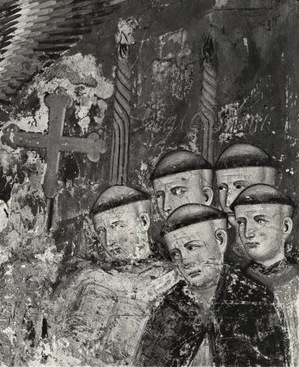
The Benedictine identity of the Institute derived especially from Mother Mectilde’s mystical understanding of the death or transitus of the great Patriarch, as recounted by Pope Saint Gregory the Great in the Second Book of the Dialogues. Mother Mectilde writes:
Wanting to leave a testimony to the love that he nourished for the Most Holy Sacrament, [Saint Benedict] could not render It a greater honour, nor a more eloquent demonstration of his faith and of his charity, than by breathing his last in Its holy presence, and by entrusting the last beats of his heart to this adorable Host. . . so as to generate, in the time fixed by God, sons of his Order, who, until the end of the world, would render to [the Most Holy Sacrament] adoration, reverence, and the witness of uninterrupted love and reparation. Do you not see, my sisters, that Saint Benedict died standing up, so as to make us understand that, in a supreme act of love, he “exhaled” the sacred Institute to which we are professed? He conceived it in the Eucharist, so that, nearly twelve centuries later, it would come to birth.