
The Passover of Saint Benedict
Transitus Domini: The Passover of the Lord
We stand today on the threshold of the Pasch, of Passiontide, the ‘Holy of Holies’ of the Church’s year. We will hear in the first Responsory for Matins tomorrow morning: ‘These are the days which you shall observe in their times. On the fourteenth day in the evening is the Pasch of the Lord. And on the fifteenth you shall celebrate a solemn feast to the Lord most high.’ Fourteen days from the Pasch of the Lord, from the Passover–and by God’s providence, this year as we stand on the threshold of the Passover, of Passiontide, we are ushered into it by the Transitus of our holy father Benedict.
Transitus: the word used to describe the death of St. Benedict is not chosen accidentally. Transitus: ‘crossing over’, ‘passing over’, for St. Benedict’s death occurred at the Passover. Blessed Ildephonse Schuster tells us that it occurred on Maundy Thursday in the year 547. And thus this feast of his Transitus on March 21st focuses us on the Passover, on the Exodus. We heard throughout this Fourth Week of Lent, in the Lessons at Matins on Sunday and in the Responsories throughout the week, about Moses, the great prophet and liberator and lawgiver of Israel, who led them in the Exodus, who instituted the Passover.
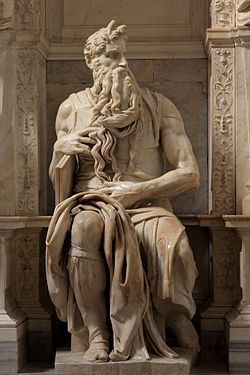
Fathers like Moses
And throughout the week we saw the figure of Moses providentially reflected in the various ‘Patriarchs’ whom we celebrated: first in St. Patrick, the lawgiver and liberator of the Irish, and then St. Joseph. The Epistle for the feast of St. Joseph was in fact taken from the Book of Ecclesiasticus’ description of the prophet Moses. St. Joseph, like Moses was also an exile who had to flee from an evil king; he was the ruler of God’s family, who led them from Egypt back to the Promised Land; he was privileged in this life to see God Incarnate face to face, to speak to Him as a man speaks to his friend. And St. Joseph, like Moses, died on the threshold of the Promised Land: not seeing the complete fulfillment of God’s promises in the Death and Resurrection of our Lord, St. Joseph, like Moses, died in hope.
Saint Benedict, a new Moses
And now today we encounter our holy father Benedict who, as St. Gregory says, was filled with the spirit of all of the just, and therefore filled also with the spirit of Moses. St. Gregory brings this out in his account of St. Benedict’s life in the Dialogues, particularly in some of the miracles that are recounted: explicitly in St. Benedict’s prayers bringing forth water from the rocky ground for his monks, and implicitly in the miraculous multiplication of food that occurs at various points.
Choosing the reproach of Christ
But the resemblance between our father St. Benedict and the prophet Moses goes much deeper than that. We heard in the Antiphon that we sang at Terce, just before Holy Mass, that ‘the blessed man Benedict preferred to endure the evils of the world rather than its praises; to be worn out by labors for God rather than to be lifted up by the favors of this life.’ And here we can hear an echo of the words of St. Paul to the Hebrews, speaking of Moses: ‘Moses rather chose to be afflicted with the people of God than to have the pleasure of sin for a time, esteeming the reproach of Christ greater riches than the treasure of the Egyptians, for he looked unto the reward.’ (Heb 11:25-26) Moses, who was raised in the household of Pharaoh, having been adopted by Pharaoh’s daughter, could have enjoyed the riches of Egypt, and instead Paul says he chose the reproach of Christ as greater riches. ‘By faith he left Egypt, not fearing the fierceness of the king, for he endured as seeing Him That is invisible.’ (Heb 11:27) Moses left what he could have had in Egypt and and he went into the wilderness, and there he encountered God and received his vocation.
Saint Benedict: liberator, lawgiver, intercessor
St. Benedict too chose to endure the hardships of this life rather than its pleasures, and so he fled from the luxurious life of the students in Rome. He went into the cave of Subiaco, and there he dwelt alone with his Creator. There, like Moses, he encountered God in fasting and in solitude. And he was then called by God to become a deliverer for His people. Preaching first to the peasants around Subiaco, and then going to the heights of Monte Cassino to dethrone the devil from his stronghold, he delivered God’s people from slavery to idols. And there on the heights of Monte Cassino, as Moses on Sinai, he became the lawgiver of monks, giving us the Holy Rule. Like Moses, too, St.Benedict had to deal with the rebellion and the murmuring of those under his care. Beginning with the monks of Vicovaro who even tried to poison him, but also throughout his life, as every father does, he had to deal with rebellion, restlessness, and murmuring from his children. But, like Moses, he interceded for them. We see him throughout his life in prayer, especially before he works miracles to obtain favours from God for those who are seeking aid. Towards the end of his life he is found weeping, foretelling the destruction of Monte Cassino that will happen within a few decades after his death, and he says that he was able to obtain by his prayer from God at least that the souls of those who were there would be saved–as Moses interceded that Israel might be spared the consequences of its sins.
Led out of the prison of Egypt
And so we see our father St. Benedict embodying the spirit of Moses, the lawgiver, the liberator, the intercessor–and above all, the one who beholds God. For St. Gregory tells us towards the end of St. Benedict’s life of the moment when he saw all the world as it were in a single beam of light: ‘to the soul who beholds the Creator all creation appears small.’ So St. Benedict, like Moses, was privileged to speak intimately to God as as a man speaks to his friend. Finally, in the last moments of his life, our father St. Benedict exemplifies for us the Passover of the Lord, the type of which was instituted by Moses. He is carried into the oratory and there he receives the Body and Blood of Christ. Like the Israelites, he is signed with the Blood of the Lamb, and then he breathes forth the spirit. The Collect of today’s Mass says that St. Benedict’s spirit was carnis eductum ergastulo: ‘led forth from the prison of the flesh.’ Ergastulum is a rather uncommon Latin word from the Greek ergon, meaning work or labour, and literally it refers to a work-house, and hence a prison where one must do hard labour, like the Israelites in Egypt. And so, the Collect tells us, St. Benedict’s spirit is led forth from the prison house of Egypt into freedom, into the promised land.
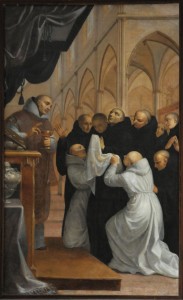
Our own Exodus
Thus Saint Benedict comes to us today on the threshold of Passiontide to prepare us for the Passover, for the Exodus. In the Holy Rule St. Benedict shows us repeatedly, not just in the liturgical chapters but in other sections as well, the central place that Easter, the mystery of the Passover, has in our lives. He comes today to teach us how to live the Passover that we are about to celebrate. It is not just a memory of an historical event. It is not just a beautiful set of ceremonies that we celebrate here. It is a way of life. We are ever to be setting out from Egypt, choosing to be afflicted with the people of God rather than to have the pleasure of sin, going out by faith as seeing Him That is invisible, with eyes fixed on the reward. ‘Behold, we have left all things and have followed Thee’, St. Peter said in the Gospel. This is the Exodus: going forth from the old life of Egypt into the freedom of the sons of God. This is what our life is called to be, not just in Passiontide, but every moment of our life: going forth from slavery into freedom, and preparing for our own definitive Passover that will come for each of us in the hour of our death.
And so as we look forward to celebrating once again the Passover of the Lord, we turn to Our Lady of Sorrows, the Regina monachorum, and to our Father St. Benedict, to gain for us the courage to undertake this Exodus that we are invited to: to leave behind the old life, to leave behind the slavery of Egypt, and to come into the freedom of the sons of God.